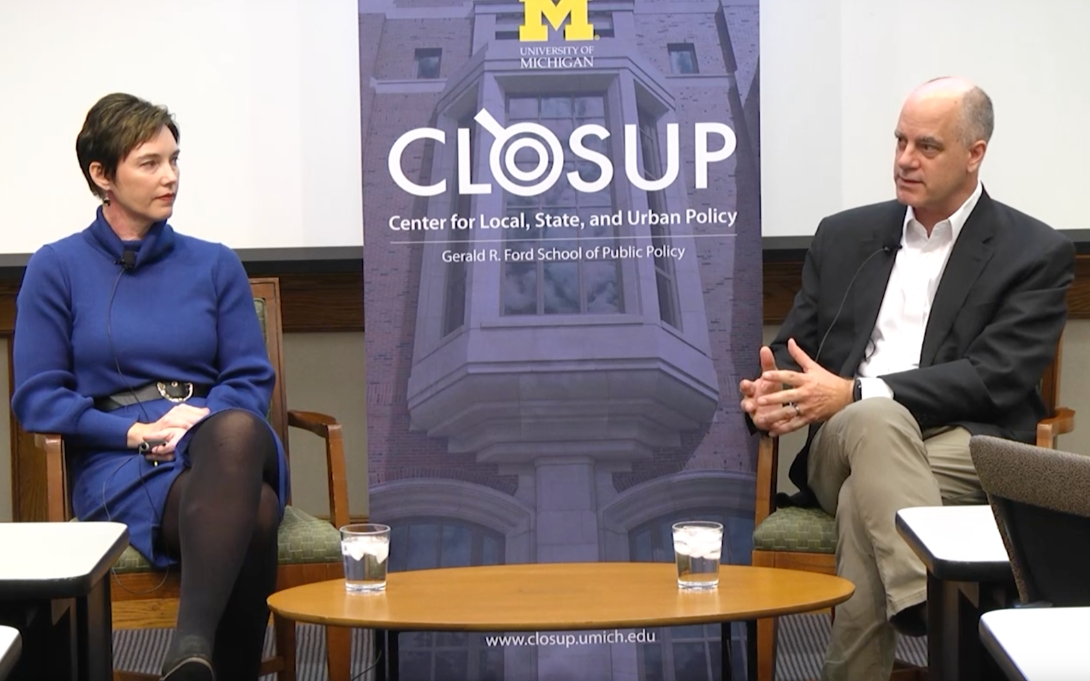
The Center is housed within the Gerald R. Ford School of Public Policy, where it helps scholars conduct policy-relevant social science research. CLOSUP functions as an information resource for policymakers and practitioners, academics, students, the media, and the public. The Center works to foster effective communication between academic researchers and the policymakers dealing with today's state, local, and urban policy problems. A second important goal of the Center is to facilitate student learning and engagement with todays critical local, state, and urban policy issues.
Latest from the Michigan Public Policy SurveySee the MPPS home page for access to pre-run data tables, survey reports, questionnaires, links to MPPS in the news, and more.
Report: State funding incentives increase local collaboration but also raise concerns
In 2011, the state of Michigan implemented major policy changes in its statutory revenue sharing program, through which it distributes funding to a subset of Michigan's 1,856 local governments. The new policy replaced formula-based funding with an incentive program that uses revenue sharing to foster local government reform. The new program, called the Economic Vitality Incentive Program (EVIP), requires local governments to certify that they have met state-specified standards for "best practices" in three categories (accountability and transparency; intergovernmental collaboration; and employee compensation policies) in order to receive their full allotment of incentive-based funds. This report focuses on the second EVIP category (intergovernmental collaboration and consolidation) and examines how Michigan's local governments are responding to the state's incentive-driven push for local reform. The findings are based on statewide surveys of local government leaders in the Fall 2011 and Fall 2010 waves of the Michigan Public Policy Survey (MPPS). View the report | View the news release
Fall 2011 MPPS Data Tables Now Online
The pre-run data tables from the Fall 2011 MPPS are now available. To view the list of available tables, click here: Fall 2011 survey Responses from the all six completed MPPS survey waves are now available online in an easy to use format. Responses to each question have been broken down by three characteristics: the type of jurisdiction (county, city, township, village); the population size of the respondents jurisdiction; and the jurisdictions region within Michigan. See the responses from the: |
This report presents the views of Pennsylvania citizens on a range of issues related to extraction of natural gas through "fracking" procedures. The report responds to a discovery of potentially massive deposits beneath the Marcellus Shale and a series of related issues concerning the economy, environmental protection, and public safety. The findings are drawn from an October 2011 telephone survey conducted by the Muhlenberg Institute of Public Opinion, in collaboration with the University of Michigan Center for Local, State, and Urban Policy. This survey secured responses from 525 residents of the state, drawn from all regions and comprising a statistically-representative profile of citizens. It examines general public attitudes on this issue as well as consideration of a series of policy options that have been introduced in state and local government circles. Key findings include: (1) more Pennsylvanians believe drilling has and will provide more benefits than problems; (2) drilling firms should be taxed and the revenue should be used for road and bridge repair or environmental protection; (3) Pennsylvanians view natural gas as a public resource and believe there should be disclosure of fracking chemicals used; and, (4) Pennsylvanians have significant doubts about the credibility of the media, environmental groups and scientists on the issue, and also believe Governor Tom Corbett is too closely aligned with the preferences of energy extraction groups.
View the report | View the news release
Upcoming events will be announced here.
See past events here.
CLOSUP Education Policy Initiative
CLOSUP announces the launch of the Michigan Consortium for Education Research (MCER), a partnership between the Michigan Department of Education (MDE), Michigan State University (MSU), and the University of Michigan (UM). The goal of MCER is to engage key stakeholders and experts in high quality education research for the benefit of public education in Michigan and nationwide. The consortium seeks to answer contemporary education policy questions. MCER provides research-based evidence to policymakers and administrators in Michigan and informs national policy initiatives for improving education. |
Education Research: The Impact of the Michigan Merit Curriculum and Michigan Promise Scholarship on Student OutcomesThis ambitious new study of the impact of the Michigan Merit Curriculum and the Michigan Promise Scholarship is funded by a $5.9 million grant from the U.S. Department of Education's Institute of Education Sciences. For more information, see the project press release. Michigan Charter School Research ProjectThe Michigan Charter School Research Project (MCSRP) is a rigorous, Michigan-wide analysis of the effect of charter schools on student performance and postsecondary schooling decisions, including college entry, choice and completion. The central goal is to use this analysis to understand charter schools' settings, practices and populations that produce positive effects on student achievement. The MCSRP is being led by Professors Susan Dynarski and Brian Jacob, Ford School faculty with over 25 years combined experience coordinating large-scale education policy research and over 60 combined publications in the field of education. The research team is collaborating with charter schools, charter school authorizers and education service providers to guarantee participation of and input from all stakeholders. The final report with results is expected for Fall 2013. More information. |